
The Essential Certification Checklist: Must-Have Standards for Your Municipal Solar Street Light Tender
- coco wang
- 2025年8月28日
- 讀畢需時 6 分鐘

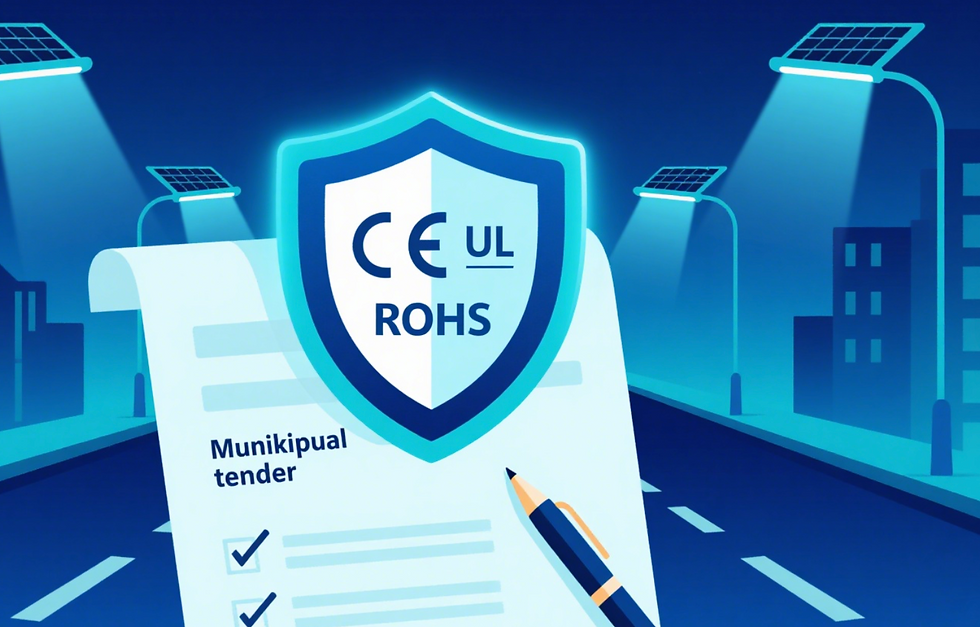
Introduction: One Checklist, Two Destinies – Why Certification is Your Project’s First Line of Defense
In any municipal solar lighting tender, the section on certifications and standards can often look like a dry collection of acronyms. For the project manager and the government procurement officer, however, this single page holds the power to determine two vastly different project outcomes: a city landmark built to last, or a failing liability plagued by frequent breakdowns and safety hazards.
Viewing certifications as a mere "entry ticket" is a costly misunderstanding. In reality, each standard is a carefully constructed "fortress wall" that not only defines a product's baseline safety and performance but also reflects a supplier's technical competence, quality management, and commitment to public responsibility. It is a stress test for your project's risk management, weeding out options that could cause endless problems down the road.
This article will peel back the complex shell of these certifications, revealing their core value. We will equip you to build an "ironclad" tender document that ensures your public investment is secure, efficient, and truly brings lasting light to your community.
Part 1: The Foundation – Your "Passport" for Market Safety & Environmental Responsibility

CE Marking: More Than Market Access, It's a Solemn Pledge of Public SafetyThe CE mark is mandatory for products entering the EU market, but its significance extends far beyond geography. For a municipal project, it confirms compliance with at least two core directives: the Low Voltage Directive (LVD) and the Electromagnetic Compatibility (EMC) Directive. This means the supplier has declared that their product meets Europe's recognized minimum safety standards regarding electrical safety (preventing shock and fire risk) and electromagnetic interference (not disrupting nearby radio and communication equipment). For a procurement officer, specifying CE is fulfilling the most fundamental duty to protect the public.
RoHS Directive: A Commitment to Long-Term Public Health and Environmental StewardshipThe "Restriction of Hazardous Substances" directive is often underestimated. It limits the use of harmful materials like lead, mercury, and cadmium. Why does this matter? First, it ensures the product minimizes harm to the environment and personnel throughout its entire lifecycle—from manufacturing and installation to eventual disposal—aligning perfectly with government ESG (Environmental, Social, Governance) goals. Second, it indirectly proves the supplier uses higher-quality, modern components and manufacturing processes, serving as powerful evidence of their corporate responsibility.
ISO 9001: Auditing the Supplier's "Quality Management DNA"This certification doesn't apply to the product itself, but to the system that creates it. An ISO 9001-certified factory demonstrates a standardized, documented process for quality management, from raw material sourcing and in-process controls to final inspection. For a project manager, this translates into lower defect rates, more reliable delivery schedules, and a more dependable partner. You aren't just buying a light; you're buying the consistent output of a robust system.
Part 2: The Performance Deep Dive – Moving from "It Works" to "It Works Well and Lasts Long"
If foundational certifications ensure a product "won't cause harm," performance standards define how "truly good" it is.

IESNA / EN 13201: The Universal Language of "Effective Illumination"
Knowing a light's lumen output is almost useless on its own. It's like knowing the size of a fire truck's water tank without knowing how far or wide its hose can spray. Standards from the Illuminating Engineering Society (IESNA) or Europe's EN 13201 are the scientific language that defines "effective illumination." They focus on what matters on the ground: Lux levels (illuminance), uniformity (no dark spots), and glare control. A professional bid must include a simulation report (e.g., from DIALux software) based on these standards, proving with data that the proposed design will achieve safe and comfortable lighting for your specific road conditions (pole height, spacing, road width), not just a uselessly bright spot under the pole.
IP & IK Ratings: The Product's Declaration of Survival in the Real World
A solar street light is a warrior exposed to the harshest elements. Its IP (Ingress Protection) rating is its "weatherproof armor." For example, IP66 means it's completely dust-tight and can withstand powerful water jets from any direction. Its IK (Impact Protection) rating is its "impact shield." For instance, IK08 signifies it can resist an impact equivalent to a 1.7 kg mass dropped from 30cm. For facility managers and contractors, a high IP/IK rating translates directly into lower maintenance costs and a longer, trouble-free operational life, protecting the long-term value of the investment.
Part 3: The System-Level Trap – Decoding the "UL Listed" vs. "UL Recognized" Minefield
In the North American market and regions influenced by it, UL is the gold standard for safety. However, a subtle distinction within its certification can become a major safety loophole for your entire project.

"UL Recognized": A "Certificate of Qualification" for a ComponentWhen a supplier claims their product "uses UL-certified batteries," they often mean the battery component is "UL Recognized." This is a good thing; it means the battery, as a standalone part, has passed UL's safety tests. But this is like saying a car's engine, tires, and airbags have all passed their individual safety tests.
"UL Listed": The "Safety Graduation Diploma" for the Entire System"UL Listed" is entirely different. It signifies that the complete, final product—the fully assembled solar street light—has passed UL's rigorous testing as an integrated system. This is crucial because a solar street light is a self-contained power plant. The way the battery, controller, solar panel, and LEDs work together presents its own unique set of potential risks (e.g., overheating, short-circuiting). Only the "UL Listed" mark guarantees that this system integration is safe.
Why This Distinction is a Matter of Life and Death for Solar SystemsFor engineers and project managers, this difference is decisive. A system built only with "UL Recognized" components can still fail or cause a fire if the integration design is poor. Demanding a "UL Listed" certification for the entire luminaire means you are entrusting the validation of the system's integrated safety to one of the world's most reputable bodies. This is the ultimate assurance for your project and for public safety.
Part 4: The Actionable Playbook – Forging an Ironclad Tender Document
Armed with this knowledge, you must translate it into precise, unassailable language in your tender documents.
Be Specific, Not Vague: Define the "Version" and "Scope" of CertificationsDon't just write "Product must be CE certified." A professional specification reads: "Product must be supplied with CE-LVD and CE-EMC certificates and full test reports issued by a recognized Notified Body." For UL, be explicit whether you require "the complete luminaire system to be UL Listed" or will merely accept "key components (e.g., battery pack) being UL Recognized."
Demand Full Third-Party Reports, Not Just a CertificateA certificate alone can be limiting or even forged. Mandate that bidders submit the complete test report from an accredited third-party laboratory. This report contains the detailed test data and methodology, serving as hard evidence for your engineers to verify true compliance. This effectively filters out bidders trying to get by with a single piece of paper.
Make Performance Standards a Mandatory DeliverableList a lighting simulation report (e.g., DIALux) based on IESNA or EN standards as a mandatory technical deliverable. Specify that the report must be generated using the project's actual parameters and must clearly show the expected on-ground illuminance, uniformity, and other key metrics. This ensures you are procuring a lighting solution that meets your needs, not just a compliant product.
Conclusion: Move Beyond the Checklist to a Logic of Trust and Data
In the world of solar LED lighting, the wisest decision-makers never treat certifications as a simple checklist. They see them as a multi-dimensional evaluation framework that provides insight into a product's safety baseline, performance ceiling, a supplier's commitment to quality, and the long-term reliability of the entire system.
When you begin to view standards and certifications through this strategic lens, you transform from a passive buyer into a proactive project risk manager. You are not just building well-lit roads; you are building a rock-solid public asset that is accountable to your citizens and responsible for the future.
Is Your Tender Document Truly Protecting Your Investment?
Navigating the complex world of solar lighting standards can be daunting. Ensure your project is built on a foundation of certified quality and verifiable performance.
Contact the expert team at nfsolar (Novafuture Tech) for a professional consultation on your project requirements and product specifications. Let's build a brighter, safer future, together.
Website: www.nfsolar.net
Email: cocowang@novafuture.net
WhatsApp: +8613013537907


留言